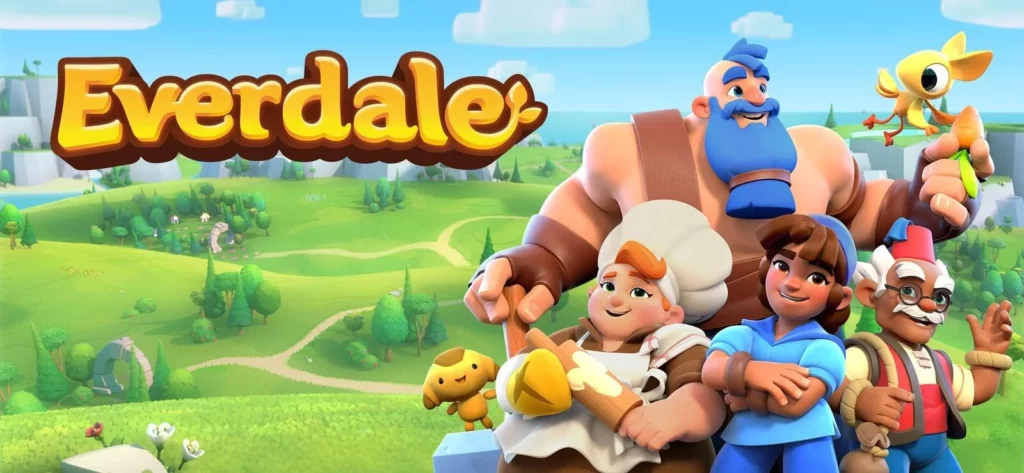
I wrote for Naavik about Supercell’s launch of Everdale. Read the full article here.
Why I wrote about this
Supercell and new games is always a hot topic. Everdale’s an unusual game in the sense that there isn’t anything quite like it out there.
The gist of it
Everdale is a co-operative farming and village-building game that can be seen as a spiritual successor to Hay Day, but with a fundamentally different design emphasis. Instead of treating social features as an endgame layer, Everdale places co-operation at the core of the experience through its Valley system, where players share construction projects, trading, and long-term progression. This creates a stronger sense of genuine collaboration than is typical in the genre.
The game also stands out through its hands-on interaction model. Players directly control individual workers in a way that resembles real-time strategy games, and little happens automatically without player input. This results in frequent short play sessions and a more demanding experience, which some players may find engaging and others may perceive as tedious.
Beyond the design itself, Everdale is notable for how Supercell has tested and iterated on the game. Originally launched in 2020 under the name Valleys & Villages via a shell publisher, the game went through multiple major updates and targeted user acquisition bursts before being reintroduced as Everdale. Despite feeling feature-complete in many areas, it has not yet launched globally and still lacks several standard free-to-play monetization systems.
Key takeaways
- Everdale puts co-operative play at the center of its core gameplay loop.
- Direct worker control makes the experience more demanding than typical farming games.
- The Valley system creates a stronger sense of shared progress than genre peers.
- Supercell tested the game extensively under a different identity before relaunching it.
- The focus appears to be on engagement and design validation rather than early monetization.