I wrote for Naavik about the rise of the “Everything Game.” Read the full article here.
Why I wrote about this
We were working on Super Run Royale at the time and the reference games all had a game-as-a-platform feel to them. That’s where the ‘Everything Game’ thesis came from.
The gist of it
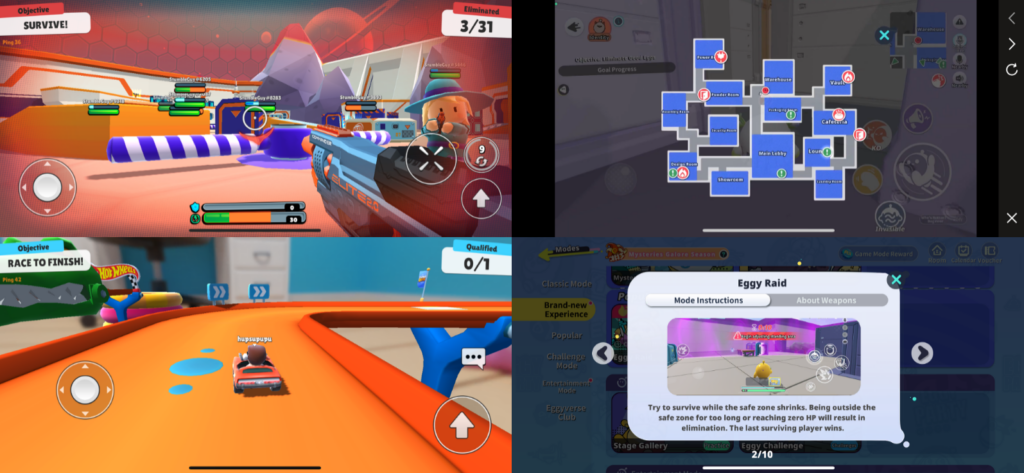
Traditional wisdom says don’t over-scope and instead ship something focused. But there are interesting exceptions to this rule: when a multiplayer game reaches critical mass, it almost becomes bigger than its core gameplay. With enough users, a title can evolve into an “Everything Game” with wildly different game modes on top of the same social graph.
Mobile-first live service titles like Stumble Guys and NetEase’s Eggy Party are prime examples. What starts as a party royale platformer turns into a container for racing, shooters, social deduction, MOBAs, battle royale clones, and even single-player modes all inside one app. It sounds incoherent, yet it somehow works. The logic is simple: the broader the in-game offering, the fewer reasons players have to churn. Once a multiplayer game becomes a place to hang around instead of just a game, adding new experiences inside the same product can be far more powerful than launching a new SKU.
Brawl Stars shows the early shape of this evolution. It already experiments with alternative modes on top of its core MOBA gameplay, but it’s still relatively focused. Nothing is stopping it from going further. Going full Everything Game would come down to whether the team wants to.
Key takeaways
- The “Everything Game” only works once a multiplayer title has real scale.
- Variety can be a retention strategy: the more tastes a game serves, the harder it is to leave.
- In a saturated market, expanding inside an existing hit may be smarter than launching a new one.
- Games like Brawl Stars could become Everything Games, if the team chooses to take them there.