
I wrote for Naavik about the duality of PlayStation: strong financial performance paired with the unraveling of its live-service strategy. Read the full article here.
Why I wrote about this
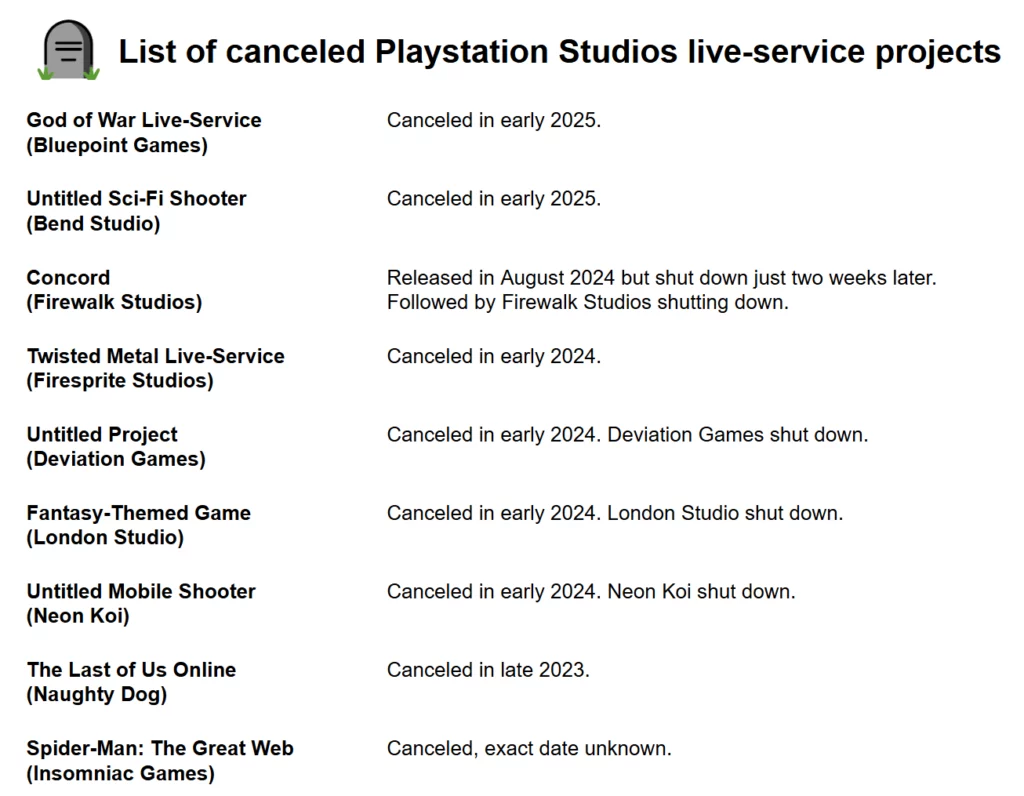
Sony’s financial report provided a good excuse to revisit its live-service strategy. Once I started listing all the cancelled and troubled projects, the graveyard turned out to be much bigger than I expected.
The gist of it
Sony’s PlayStation division is in a strong financial position. In FY2024, the Game & Network Services segment generated ¥4.6 trillion ($31.5B) in revenue and ¥415 billion ($2.8B) in operating profit. However, most of the growth came from the platform side of the business — third-party game sales and PlayStation Plus — while both hardware sales and first-party software revenue declined year-over-year. Currency effects also inflate the headline numbers, making the underlying growth story less dramatic than it first appears.
At the same time, Sony’s ambitious live-service strategy is unraveling. The company originally planned to launch 12 live-service games by 2026, but that roadmap has shrunk dramatically after several cancellations and high-profile failures, most notably the disastrous launch of Concord. With projects like Marathon and Fairgame$ also facing turbulence, the strategy that was supposed to secure PlayStation’s long-term growth now looks increasingly unlikely to deliver.
Looking ahead, Sony has a few potential growth levers: hardware, cross-platform releases, and acquisitions. None of these appear transformative on their own. But the company’s traditional formula — premium consoles and blockbuster exclusives — is still working. PlayStation may not have found a bold new growth engine, yet the platform remains highly profitable and continues to outperform Xbox in the current console cycle.
Key takeaways
- PlayStation’s profits are rising, but the growth is driven primarily by platform revenue (third-party sales and subscriptions), not new first-party hits.
- Sony’s ambitious plan to launch 12 live-service games has largely collapsed after multiple cancellations and the failure of Concord.
- Potential growth avenues (hardware, PC releases, and acquisitions) offer no clear breakout strategy.
- Sony’s traditional model of premium hardware and blockbuster exclusives remains highly profitable.
- Doing nothing special is still beating Xbox’s haphazard strategy.