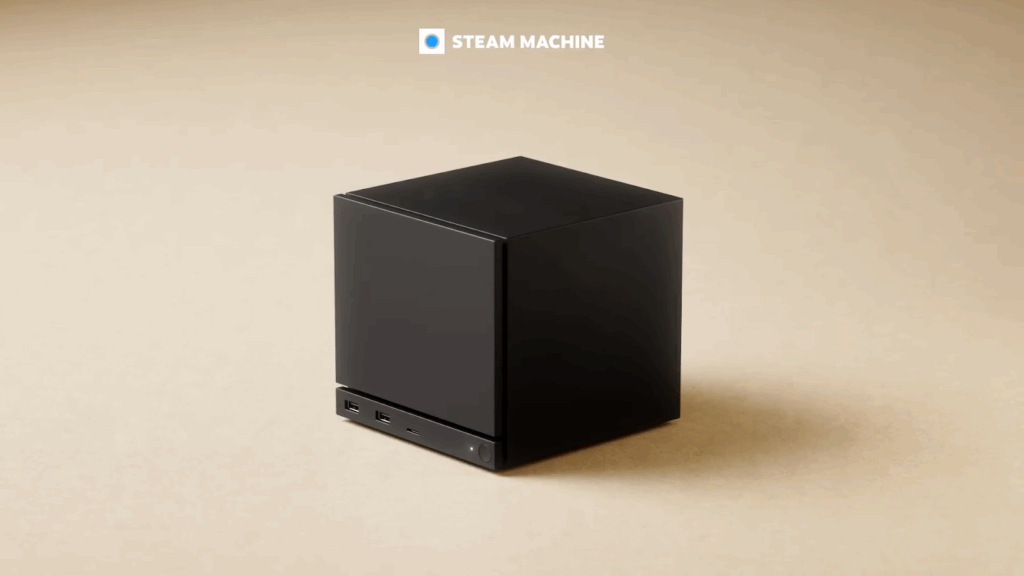
I wrote for Naavik about Valve’s new Steam Machine and why the real story isn’t the box under your TV, but SteamOS itself. Read the full article here.
Why I wrote about this
Valve just resurrected the Steam Machine, a concept that famously flopped a decade ago. On the surface, this looks like another hardware experiment. But the more interesting angle is Valve’s efforts to reduce its dependence on Windows.
The gist of it
The new Steam Machine is a compact, console-sized PC running SteamOS with Proton. In practice, it lets players access most of their Steam library on a TV without installing Windows. Compared to the Steam Deck, it’s more powerful. But compared to a PS5, it’s weaker, especially on GPU and VRAM. While it technically supports 4K, that depends heavily on upscaling, and native 4K for demanding titles is unrealistic.
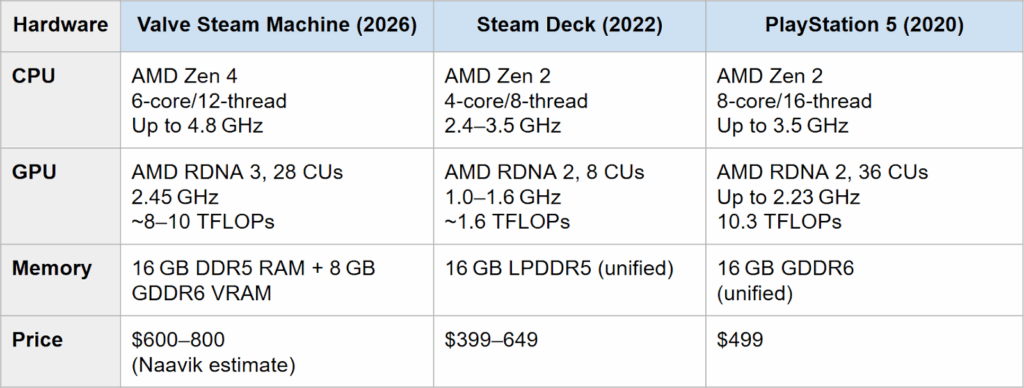
Price is the bigger issue. Valve isn’t subsidizing the hardware, so consumers should expect PC-like pricing in the $600–$800 range. That’s significantly above a $500 PS5 that also outperforms it. In other words, this is a midrange gaming PC in a console shell.
That said, the environment today is very different from 2015. SteamOS and Proton are now proven at scale thanks to the Steam Deck. Valve is building the hardware itself instead of relying on fragmented OEM partners. Steam’s user base and average library size have grown dramatically, increasing the appeal of a couch-friendly device. And the timing, late in the console cycle, gives Valve some breathing room.
But real challenges remain. Kernel-level anti-cheat games like Fortnite, Valorant, Apex Legends, and Battlefield still don’t run. Non-Steam titles are cumbersome to install. Specs are middling. And asking mainstream console buyers to pay more for less performance is a tough sell. Which is why the Steam Machine probably isn’t meant for the mainstream.
The bigger story is SteamOS. Valve’s new Steam Frame VR headset quietly demonstrates another piece of the strategy: running traditional x86 PC VR apps on ARM hardware using an emulation layer called FEX. Just as Proton lets Linux run Windows games, FEX allows ARM chips to run x86 software. Valve is methodically building compatibility layers that make Steam portable across architectures.
From a business standpoint, this is the long game. Valve is one of the most profitable companies in gaming and can afford to think in decades. Every Steam Deck and Steam Machine sold expands the SteamOS install base, reduces developer reliance on Windows, and weakens Microsoft’s platform leverage. If Steam can run anywhere — on x86, on ARM, on handhelds, on living room boxes — Valve controls its own destiny.
Seen through that lens, the Steam Machine is less about competing with Sony and more about ensuring Steam survives independently of Windows. Just don’t expect it to become the third major console anytime soon.
Key takeaways
- The Steam Machine is unlikely to compete with PlayStation or Switch at scale. It’s a niche device for dedicated Steam users.
- SteamOS + Proton is finally mature enough to deliver on what the original Steam Machine promised.
- Price and anti-cheat compatibility are the biggest structural barriers to mass adoption.
- Valve’s hardware is a vehicle to grow the SteamOS install base.
- The real strategy is to reduce reliance on Windows and make Steam run anywhere, on any chip architecture.